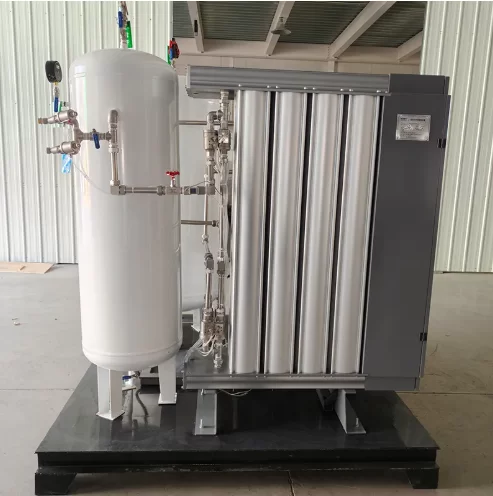
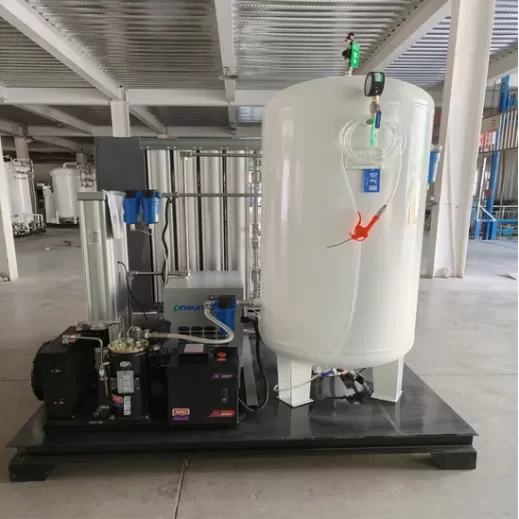
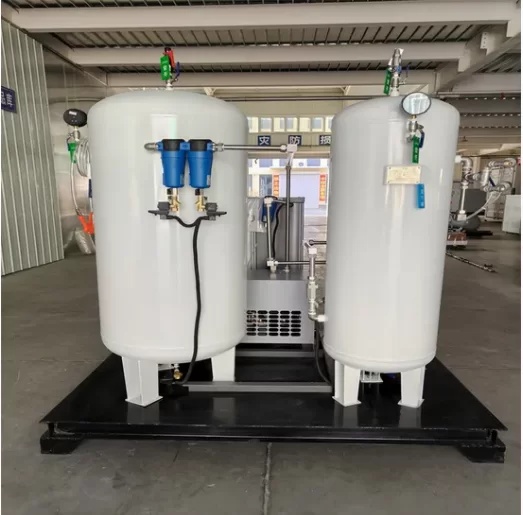
The High Purity Medical Oxygen Generator is a reliable on-site solution for producing high-purity medical oxygen for hospitals and clinics. It delivers oxygen purity up to 93% for a continuous supply of medical-grade oxygen used in patient care and respiratory therapy.
Our high-purity medical oxygen generator uses Pressure Swing Adsorption (PSA) technology to produce oxygen directly from compressed air. Designed to meet stringent medical requirements, it delivers a stable, continuous oxygen supply with purity levels up to 93%, suitable for a wide range of clinical applications.
The system is engineered for durability and efficiency. It includes integrated compressors, air dryers, molecular sieve adsorption beds, and intelligent control systems. Its modular design enables straightforward installation and scalable operation, making it suitable for both small clinics and large hospitals.
By producing oxygen on-site, healthcare facilities can reduce reliance on costly and logistically complex cylinder supply, helping ensure uninterrupted oxygen availability—even in emergency situations. This supports better patient care, optimizes operating costs, and contributes to more sustainable healthcare practices.
Hospitals:
Provides oxygen for intensive care units (ICUs), surgical theatres, emergency rooms, and general patient respiratory support.
Clinics and Health Centers:
Supplies reliable oxygen for outpatient treatment, minor surgical procedures, and respiratory therapy.
Home Healthcare Providers:
Supports portable oxygen therapy devices for patients requiring long-term oxygen support at home.
Emergency Medical Services (EMS):
Delivers a dependable oxygen source for ambulances, field hospitals, and disaster relief units.
Pharmaceutical and Medical Research:
Supplies high-purity oxygen required for pharmaceutical manufacturing and laboratory processes.
Product Details
Customization: |
Available |
After-sales Service: |
1 Year |
Warranty: |
1 Year |
|
Model NO. |
1-100 cubic modular oxygen
|
Certification |
ISO9001 |
|
|
Noise Level |
70 (dB) |
Voltage |
380V |
|
|
Purity |
Reference/typical range: 90-96% |
Operational Principle |
Molecular Sieve Pressure Swing
|
|
|
Drug and Equipment Approval
|
Ji Xi Zhu Zun 20232080171 |
Usage |
Oxygen Production |
|
|
Performance |
Energy Saving |
Extraction Gas Status |
Oxygen |
|
|
Transport Package |
Wooden Box |
Specification |
1-100 cubic meters |
|
|
Trademark |
Lixin Zhexing |
Origin |
Hebeihengshui |
|
|
HS Code |
8419601900 |
Production Capacity |
500 Sets/Year |
Product Description
The main structure of the product
This product mainly consists of an oxygen generator, an air storage tank, an oxygen storage tank, a flow meter, and other components. These units are connected to each other via gas piping. The oxygen production host includes a chassis; an air compression system (air compressor, pressure sensor); a gas source purification system (refrigerated dryer, suction dryer, filter); a medical molecular sieve adsorption and separation system (adsorption tower, molecular sieve, electronic drain valve); a control system (PLC controller, contactor, touch screen); and a monitoring and alarm system (oxygen analysis module), among other components. These elements are interconnected through gas pipes and cables.
How High Purity Used in Hospitals and Clinics Medical Oxygen Generator Ensures Reliable Patient Care
A high-purity used in hospitals and clinics medical oxygen generator plays a critical role in supporting reliable patient care by ensuring a continuous, controlled supply of high-quality medical oxygen. Unlike traditional oxygen cylinders that require frequent refilling, transportation, and storage arrangements, an oxygen generator allows healthcare facilities to produce oxygen on-site using PSA (Pressure Swing Adsorption) or membrane separation technology. This guarantees uninterrupted access to oxygen—essential for patients suffering from respiratory diseases, cardiac complications, trauma, or other critical medical conditions.
One key advantage is the level of purity the system can achieve. High-purity oxygen—typically reaching concentrations of 93% to 99%, depending on the system—meets medical-grade standards required in hospitals and clinics. This purity supports safe and effective oxygen delivery to patients via ventilators, anesthesia machines, high-flow nasal cannula systems, and oxygen therapy devices. Maintaining consistent purity levels helps reduce risks such as infection, contamination, and inadequate oxygenation.
In addition, a medical oxygen generator improves operational efficiency within healthcare environments. Because oxygen is produced on demand, medical staff no longer need to manage inventory schedules, coordinate cylinder deliveries, or respond to oxygen shortages during peak demand periods. This is especially important in emergency rooms, intensive care units (ICUs), neonatal care units, and surgical departments where oxygen demand can change rapidly. Reliable continuous production reduces strain on emergency logistics and supports stable clinical operations.
From a healthcare management perspective, on-site oxygen generation can also strengthen long-term cost control. Hospitals and clinics can reduce recurring costs associated with cylinder rental, transportation, and handling. In addition, it helps reduce accidental hazards related to storing high-pressure cylinders. Oxygen generators include intelligent monitoring functions that track purity levels, output pressure, and maintenance status, enabling technicians to ensure reliable performance and continued alignment with medical gas standards.
With regard to patient outcomes, reliable access to high-purity oxygen helps support improved recovery, enhanced respiratory support, and more capable treatment options. This is important for conditions such as COPD, pneumonia, asthma, COVID-19 complications, and other respiratory syndromes where oxygen therapy is part of standard treatment. In critical moments, delivering oxygen without delay can be life-saving.
Overall, a high-purity used in hospitals and clinics medical oxygen generator strengthens patient care reliability through continuous oxygen availability, consistent purity performance, safer operational conditions, and long-term cost and efficiency benefits. It is becoming an essential component of medical infrastructure for modern healthcare institutions worldwide.
Advantages of High Purity Used in Hospitals and Clinics Medical Oxygen Generator for Healthcare Facilities
A high-purity used in hospitals and clinics medical oxygen generator provides multiple advantages for healthcare facilities, improving operational efficiency, clinical safety, and financial sustainability. As global demand for medical oxygen continues to increase, many hospitals and clinics adopt on-site oxygen generation systems as a strategic alternative to traditional cylinder-based supply methods.
One of the most significant benefits is cost reduction. Oxygen generators remove the need for continuous cylinder purchasing, transportation, refilling services, and storage management. Over time, this can lead to substantial savings—particularly for facilities with high oxygen consumption, such as emergency departments, ICUs, surgical wards, and chronic care units. The initial equipment investment is typically balanced by reduced logistics costs and minimized waste.
Another major advantage is operational independence. By producing oxygen on-site, healthcare facilities are less exposed to supply chain delays, cylinder shortages, and price fluctuations. During medical emergencies, pandemic-related demand, or seasonal peak periods, the assurance of continuous oxygen output becomes highly valuable. This autonomy improves hospital readiness and reduces dependence on external suppliers.
From a clinical standpoint, the high-purity capability of these generators supports compliance with oxygen therapy standards. With purity levels reaching up to 99% depending on the system configuration, oxygen generators can safely support a broad range of applications, including respiratory support, anesthesia, neonatal care, critical care ventilation, and post-operative recovery. Stable purity levels also help minimize treatment risk and support more predictable therapeutic outcomes.
Safety improvement is another important advantage. Traditional oxygen cylinders involve risks such as explosion hazards, high-pressure leaks, and accidents during transportation. In contrast, oxygen generators produce oxygen at lower pressures and do not require large cylinder storage areas, significantly reducing operational hazards. Facilities benefit from safer workflows and a more streamlined medical gas infrastructure.
Moreover, modern medical oxygen generators include intelligent monitoring systems that continuously track output purity, flow rate, and pressure. These digital features allow maintenance teams to identify abnormalities early, plan preventive servicing, and meet regulatory compliance requirements. Automated alarms and purity measurement sensors further enhance overall system reliability.
Environmentally, oxygen generators can provide a cleaner solution by reducing the carbon footprint associated with cylinder logistics. Hospitals and clinics pursuing environmental sustainability initiatives may benefit from reduced transportation emissions and more efficient resource utilization.
In summary, the high-purity used in hospitals and clinics medical oxygen generator offers clear advantages, including cost savings, stable supply, enhanced patient safety, improved clinical outcomes, reduced operational risks, and environmental benefits. These advantages make on-site oxygen generation an increasingly preferred option for modern healthcare facilities.
Why High Purity Used in Hospitals and Clinics Medical Oxygen Generator Is Essential for Emergency Treatment
A high-purity used in hospitals and clinics medical oxygen generator is essential for emergency treatment because it ensures rapid, continuous, and safe access to medical-grade oxygen during critical healthcare situations. In emergency scenarios, patients may experience respiratory distress, cardiac arrest, trauma, shock, severe infections, or complications that require immediate oxygen therapy. Any delay or shortage in oxygen supply can significantly worsen clinical outcomes.
One of the key reasons these generators are crucial in emergency care is continuous oxygen availability without logistical delays. Traditional cylinder-based oxygen systems require transport, replacement, and manual handling. During emergencies—especially in high-demand environments such as emergency rooms and intensive care units—cylinder supply may become unstable. In contrast, an oxygen generator produces oxygen on-site, reducing the risk of supply interruption during life-threatening situations.
High-purity oxygen is also vital for emergency medical protocols. Many life-saving interventions—such as intubation, mechanical ventilation, CPR support, trauma resuscitation, and high-flow nasal cannula therapy—depend on oxygen that meets clinical purity standards. Generators delivering 93%–99% purity help ensure that patients receive oxygen that is both safe and therapeutically effective, reducing respiratory workload and improving tissue oxygenation during critical treatment windows.
In disaster response or public health emergencies such as pandemics, earthquakes, or mass casualty incidents, oxygen demand can increase rapidly. Hospitals relying solely on oxygen cylinders may face shortages or delivery delays. An on-site oxygen generator helps transform a healthcare facility into a more self-sufficient emergency center, capable of sustained high-volume oxygen output if external logistics are disrupted.
Furthermore, in emergency treatment, time is critical. Any interruption in oxygen flow during ventilation or anesthesia can directly endanger patient survival. Medical oxygen generators reduce these risks by providing stable pressure, controlled flow rates, and real-time system monitoring. Integrated alarms and purity sensors notify medical staff immediately if oxygen concentration or system performance deviates from expected operation.
From the perspective of emergency medical teams, having a reliable oxygen source improves coordination and treatment capability. Emergency physicians, anesthesiologists, respiratory therapists, and trauma surgeons can carry out procedures more confidently when oxygen supply is assured. This directly influences the speed and success of emergency interventions.
In rural or remote clinics where emergency transport infrastructure is limited, oxygen generators are often the most practical option for life-support treatment. Their reduced dependence on cylinder delivery logistics supports continuous emergency response capacity.
Overall, a high-purity used in hospitals and clinics medical oxygen generator is indispensable for emergency treatment due to its ability to ensure immediate availability, stable purity, uninterrupted output, and self-sufficient operation under extreme conditions. Together, these factors support more effective emergency care, improved survival outcomes, and better patient recovery.